
IND.06 — MODULAR CONSTRUCTION
Sell the method and the firm at once
BoxBuild helps modular construction companies win work by solving the two-front sale every volumetric builder faces: legitimizing the method and positioning the firm. We build education-first websites that dissolve durability, financing, and appraisal doubts, make you findable in the searches and AI queries where developers and homebuyers research modular, and wire follow-up systems that survive the long consideration cycle this method demands.
Modular builders fight a two-front sale: convince the buyer that volumetric construction is real, then convince them you are the firm to deliver it. We build the education, proof, and follow-up system that wins both arguments — because we started in off-site and never left.
The market moment
Modular construction is having its most credible run in decades. The Modular Building Institute puts the U.S. modular market at $20.5 billion in 2025 — about 5.1% of construction activity in its key segments — and projects 6.5% annual growth through 2030. Behind those numbers sits a simple driver: the industry must attract an estimated 349,000 net new workers in 2026 just to meet demand (Associated Builders and Contractors), and factory hours are easier to secure than field hours. When labor is the constraint, moving work into a controlled environment stops being an experiment and starts being a schedule strategy.
That tailwind cuts both ways. Developers, institutions, and homebuyers are more open to modular than they have ever been — but openness is not conviction. Every modular builder still sells against the same quiet doubts: is factory-built durable, will a lender and appraiser treat it like a real building, and is this firm a manufacturer, a contractor, or something in between? The buyers arriving today are curious, better-informed, and still one unanswered doubt away from defaulting back to site-built.
There is a second structural problem. Modular marketing inherits an audience that is split in two. A multifamily developer evaluating volumetric delivery for a 200-unit project and a homeowner researching a factory-built house run entirely different vetting processes — but both land on the same website. Most modular sites fail one audience trying to serve the other, or fail both by staying generic.
The firms winning right now treat the education itself as the marketing. They answer the doubts in public, show the factory alongside the finished product, and are present in the searches — increasingly AI-assisted searches — where the method gets researched before any firm gets contacted.
THE SHORT ANSWER
THE OFF-SITE MOMENT
U.S. modular construction market in 2025 — about 5.1% of key-segment activity
SRC — MODULAR BUILDING INSTITUTE, 2026
Projected annual growth of U.S. modular construction through 2030
SRC — MODULAR BUILDING INSTITUTE, 2026
Net new workers construction must attract in 2026 (456K in 2027)
SRC — ASSOCIATED BUILDERS & CONTRACTORS, 2026
“In modular you sell the method and the firm at once. The buyer’s doubts are the sales funnel — answer them in public.”
How buyers in this space vet you
Whether the buyer is a developer or a household, modular vetting follows the same arc: method first, firm second. Before anyone asks for a quote, they have been through a research cycle that decides whether you are even in the running.
- Method legitimacy. They looked for evidence that volumetric construction produces buildings that last — finished projects, not renders, next to the process that made them.
- Financing and appraisal clarity. The Modular Building Institute has flagged financing friction for years, and buyers feel it. If your site is silent on how lenders, draws, and appraisals work for modular, the silence reads as a hidden problem.
- Factory reality. Buyers want to see the plant: capacity, quality control, who owns the production line. A modular builder with no visible factory story looks like a broker.
- Code and approvals fluency. State modular programs, third-party inspection, set and stitch — buyers check whether you speak the regulatory language of factory-built work or hide it.
- Delivery track record. Named projects with unit counts, schedule performance, and the site-work story. Modular fails at the interface between factory and field, and sophisticated buyers know it — so they look for proof you manage that interface well.
A developer runs this check across your website, your leadership's profiles, and whatever an AI assistant says about you. A homeowner runs it across your site, your reviews, and your project gallery. Either way, the verdict lands before the first conversation.
What a growth system looks like here
Traffic
Modular search demand is a genuine asset — the method generates research-stage queries most construction verticals never see: what modular construction costs, modular versus site-built, how modular homes are financed. Construction SEO for a modular firm means owning those method queries in your operating footprint, then converting method interest into firm interest. It also means being the answer AI tools cite when a developer asks who builds volumetric multifamily in a region — answer-engine visibility is disproportionately valuable where buyers research a method, not just a vendor. Google Ads earns its keep on high-intent segments — modular home builder plus state, ADU plus city — where the searcher has moved from method to shortlist.
Trust
The trust layer has to do double duty: legitimize modular and differentiate you. That means education content that names the doubts — durability, financing, appraisal, resale — and answers them without flinching. It means factory pages with real capacity numbers and quality process, project pages that pair finished buildings with production photos, and financing content written plainly enough that a first-time modular buyer can forward it to their lender. We built exactly this positioning for Maui Modulars: the brand had to carry the modular-versus-site-built argument itself, so the website was built to make that case, not decorate it.
Conversion & follow-up
Modular consideration cycles are long, because the buyer is deciding on a method and a firm at once. The system has to capture interest early — a question, a feasibility check, a catalog request — and then nurture it through the doubt-resolution phase without a salesperson manually remembering anyone. CRM and follow-up automation keeps six-month deliberations alive, routes developer inquiries differently than homeowner inquiries, and makes sure the first response lands while your competitor is still checking voicemail.
Generic agency vs. a vertical-built system
| Generic agency | BoxBuild vertical-built system | |
|---|---|---|
| Understands the two-front sale | Sells the firm only | Method education + firm positioning |
| Buyer-doubt content | Avoids the doubts | Durability, financing, appraisal answered |
| Developer vs. homeowner paths | One generic funnel | Split journeys, split follow-up |
| Findable in AI + search | Vanity keywords | The method queries buyers actually research |
Where to start
Start where the sale actually breaks: the trust layer. A website built for the two-front modular sale — education first, factory visible, financing answered — is the asset every other channel amplifies. Then make the method demand findable with construction SEO, and put follow-up automation underneath so long deliberations become signed contracts instead of cold files.
For the full strategic picture of how factory-built firms win buyers this cycle, read our off-site construction marketing playbook. If your work sits closer to a specific product line, see the adjacent pages: prefab construction, panelized construction, container construction, and ADU builders. And modular capability is being screened for far beyond housing — prefabricated data halls and skid-built plant are now schedule strategy in data center construction too. We built our practice in this corner of the industry — it is where BoxBuild started, and it is still the work we know deepest.
How we build the vertical
- 01
Scope the buyer
We map how modular owners actually source and vet — the formal gates and the quiet online research that decides who gets invited.
- 02
Build the evidence
Project pages organized by scope, delivery method, and outcome — the documentary proof this buyer checks before your name moves forward.
- 03
Engineer the trust layer
Safety, capacity, certifications, and key personnel made visible in the buyer’s own language, so the silent evaluation lands in your favor.
- 04
Make it findable
SEO, answer-engine visibility, and paid coverage aimed at the searches and AI queries that precede a shortlist, not vanity keywords.
SCOPE OF WORK — MODULAR CONSTRUCTION
- 01Method Positioning
- 02Buyer-Doubt Content
- 03Factory & Proof Pages
- 04Demand Capture
- 05Long-Cycle Follow-Up
- 06Reporting
PROOF — CASE STUDY
Maui Modulars
Maui Modulars needed more than a website — it needed a position. Modular construction has a distinct case to make to buyers weighing it against site-built, and the brand had to carry that argument clearly. The company also had no appetite for managing hosting, updates, and technical upkeep itself.
Read the full case study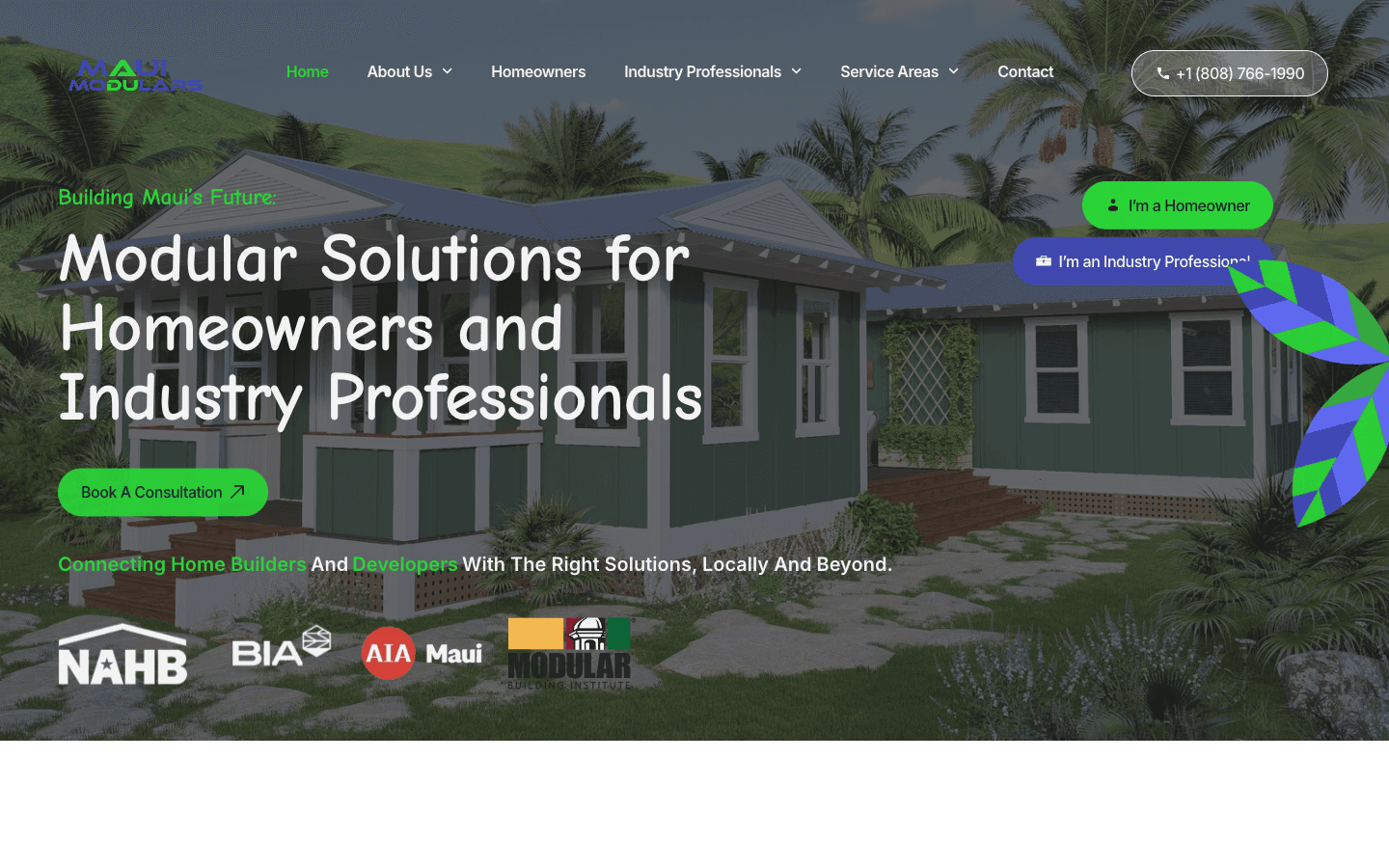
Modular Construction — questions we hear
How do modular construction companies market to developers versus homeowners?
With separate journeys, because the vetting is completely different. A developer evaluates volumetric delivery on unit economics, factory capacity, and schedule certainty; a homeowner evaluates trust, financing, and whether the house will feel real. The website needs distinct paths — developer proof organized around capacity and delivered projects, homeowner education organized around doubts — and the CRM should route and nurture each audience differently. One generic funnel fails both.
Does SEO work for modular construction companies?
Yes — modular is one of the few construction verticals with genuine method-level search demand. Buyers research what modular costs, how it compares to site-built, and how financing works long before they shortlist firms. Owning those questions in your operating footprint captures buyers at the research stage, and the same content earns citations when AI tools answer modular questions. The mistake is chasing generic construction keywords instead of the method demand.
What should a modular builder’s website include?
Everything the two-front sale requires. Method education that answers durability, financing, and appraisal doubts plainly. A visible factory story — capacity, quality control, who owns the line. Project pages pairing finished buildings with the production process behind them. Code and approvals fluency for your states. And conversion paths split by audience, so a developer inquiry and a homeowner inquiry each get a first step that fits.
What doubts do buyers have about modular and off-site construction?
Modular and off-site buyers carry three main doubts: durability, financing, and legitimacy. They quietly wonder whether factory-built means flimsy, whether a lender or appraiser will treat the project like a normal build, and whether choosing modular is a serious decision or a fad. Naming these doubts openly is more persuasive than ignoring them, because the buyer already has them and is watching to see if you address them.
How do you market factory-built modular construction to skeptical buyers?
You educate and de-risk before you ask for the inquiry. Lead with content that explains the method, show finished projects beside the process that produced them, and be transparent about financing. A skeptical buyer will not respond to a call-to-action they do not trust yet, so let them answer their own objections with your material first. By the inquiry, the conversation starts warm instead of defensive.
How do you convert a halfway-skeptical modular construction visitor into a lead?
Structure the site so it removes the last doubt and makes the next step feel low-risk. The visitor should land on education, move to proof, see financing handled, then find a clear low-pressure way to start a conversation. Put case studies where the doubting buyer hits them so proof arrives before the ask, and make the first step small, a question or a consultation, not a commitment.
Related
Website Design & Development
Construction website design and development engineered for trust and conversion, built for how owners, developers, and procurement teams actually vet builders.
Learn moreConstruction SEO
Construction SEO built around how owners research builders: vertical pages, technical SEO, and answer-engine optimization that reach buyers before the RFP.
Learn moreGoogle Ads
Google Ads management for construction companies: vertical campaigns, landing pages built to convert, and reporting measured on qualified pipeline, not clicks.
Learn moreCRM & Automation
CRM and automation for construction firms: instant lead response, staged nurture across long sales cycles, and pipeline visibility your leadership can trust.
Learn moreAI Systems
AI systems for construction businesses: content engines, lead qualification, AI workflows, BI dashboards, and internal operating systems measured on results.
Learn moreTalk to the team that speaks your vertical.
A 30-minute strategy call. We’ll map where trust, conversion, or follow-up is costing you work in your vertical.