
More than 60 percent of American modular construction firms now rely on data-driven marketing to outpace competitors and win complex contracts. For marketing managers in North America, traditional intuition is no longer enough to identify high-value leads and boost conversions in the fast-changing off-site sector. This overview reveals how precise analytics and targeted digital strategies can help sharpen outreach, fuel project opportunities, and unlock real business growth.
Table of Contents
- Defining Data-Driven Construction Marketing
- Major Types of Construction Marketing Data
- How Analytics Shapes Lead Generation
- Applying Data For Targeted Campaigns
- Common Pitfalls In Using Data Effectively
Key Takeaways
| Point | Details |
|---|---|
| Data-Driven Approach | Implementing data-driven marketing enables construction firms to create targeted campaigns based on comprehensive analytics and client insights. |
| Comprehensive Data Types | Key construction marketing data includes digital performance metrics and audience engagement analytics, which aid in crafting strategies that resonate with specific client segments. |
| Analytics in Lead Generation | Utilizing predictive analytics allows for improved lead scoring and efficient resource allocation, enhancing the overall lead generation process. |
| Avoiding Common Pitfalls | To maximize data efficacy, firms should integrate data sources and focus on actionable insights while maintaining consistent data collection processes. |
Defining Data-Driven Construction Marketing
Data-driven construction marketing represents a strategic approach that transforms traditional marketing practices by leveraging digital insights, analytics, and advanced technologies to create precise, targeted campaigns. Unlike conventional methods relying on intuition, this approach uses comprehensive data analytics to optimize marketing strategies across the construction ecosystem.
At its core, data-driven construction marketing integrates multiple data sources including project historical records, client interaction metrics, market research, and digital engagement analytics. By systematically collecting and analyzing these diverse data points, modular construction marketing managers can develop highly targeted strategies that resonate with specific client segments. The goal is not just collecting data, but transforming raw information into actionable insights that drive business growth and competitive positioning.
The fundamental components of a robust data-driven marketing approach include advanced tracking technologies, predictive analytics tools, and sophisticated customer segmentation models. Marketing teams can now map entire customer journeys, understand precise pain points, and craft messaging that addresses specific needs with unprecedented accuracy. Digital transformation is reshaping how construction firms approach marketing strategies, moving beyond traditional broad-based campaigns toward laser-focused, personalized communication techniques.
Pro tip: Start by implementing a comprehensive Google Analytics setup with custom event tracking to capture nuanced interactions specific to your construction marketing ecosystem.
Major Types of Construction Marketing Data
Constructing a comprehensive marketing data strategy requires understanding the diverse types of digital information available to modular construction professionals. Marketing data in the construction industry encompasses a wide range of metrics and insights that enable targeted, intelligent business approaches. These data types fall into several critical categories that provide actionable intelligence for marketing teams.
The primary categories of construction marketing data include digital performance metrics, audience engagement analytics, and project-specific insights. Digital performance metrics cover website traffic, conversion rates, and online advertisement performance. Audience engagement analytics track social media interactions, email campaign responses, and content consumption patterns. Project-specific insights involve historical project data, client demographic information, and behavioral tracking that reveals potential market opportunities.

Moreover, construction marketing data extends beyond traditional digital metrics to include sophisticated tracking mechanisms. These include virtual tour engagement rates, blog post interaction data, influencer marketing impact assessments, and comprehensive portfolio performance analytics. By integrating multiple data streams, marketing teams can develop nuanced understanding of client preferences, market trends, and competitive positioning. This holistic approach transforms raw data into strategic marketing intelligence that drives targeted outreach and business growth.
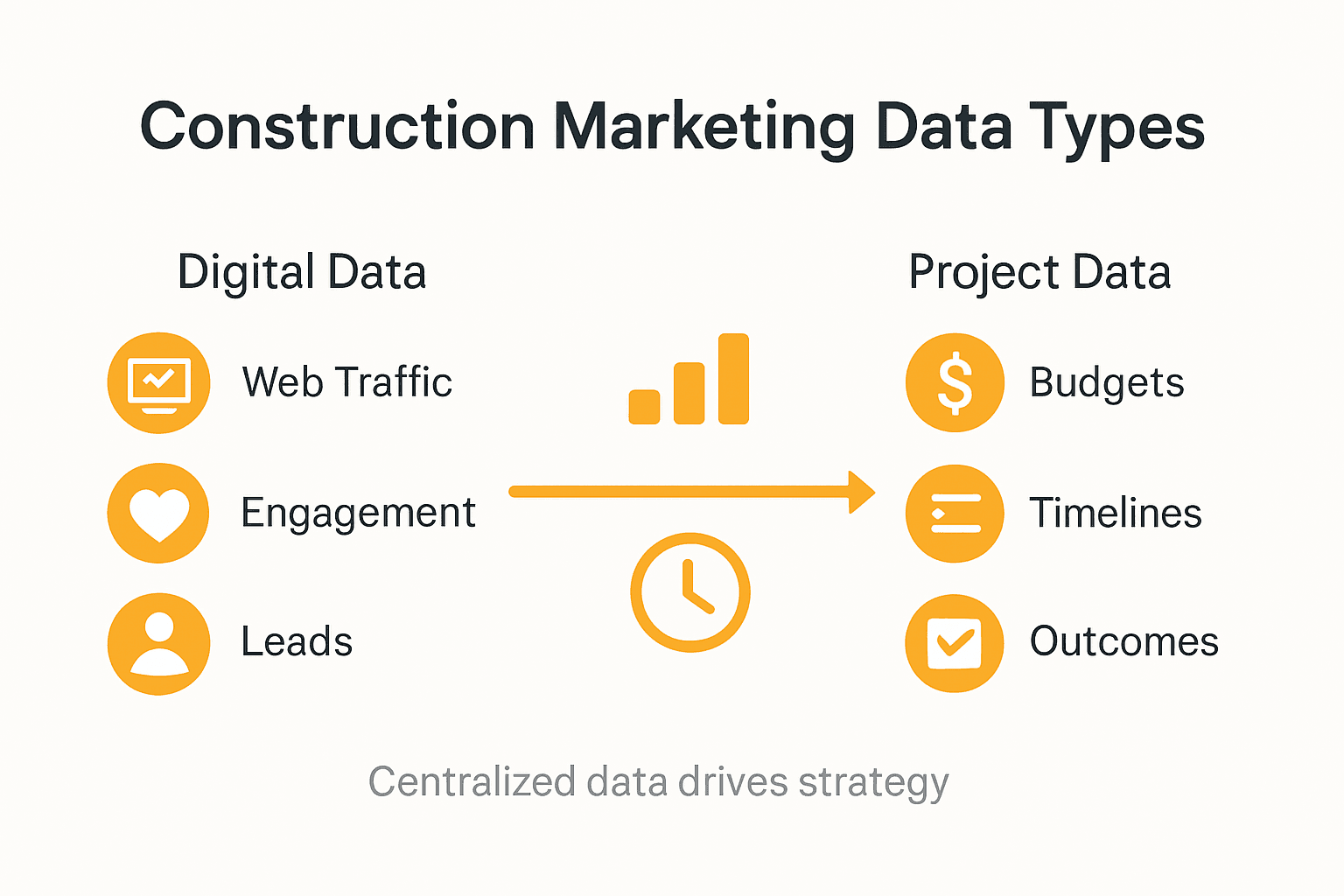
Here’s a summary of major construction marketing data types and how each supports business objectives:
| Data Type | Key Metric Example | Strategic Value |
|---|---|---|
| Digital Performance Metrics | Website traffic | Measures reach and interest |
| Audience Engagement Analytics | Social media interactions | Assesses engagement and brand presence |
| Project-Specific Insights | Client demographics | Identifies target segments for campaigns |
| Advanced Tracking Mechanisms | Virtual tour engagement | Reveals interest in specific services |
Pro tip: Implement a centralized data management system that integrates multiple analytics platforms to create a unified view of your marketing performance across different digital channels.
How Analytics Shapes Lead Generation
Analytics has fundamentally transformed lead generation in the construction marketing landscape, providing unprecedented capabilities for precision targeting and strategic prospect identification. Predictive analytics now revolutionizes lead generation by enabling sophisticated scoring, targeting, and personalization strategies that dramatically improve marketing efficiency.
The core mechanism of analytics-driven lead generation involves complex data processing and intelligent interpretation. Marketing teams can now leverage historical behavioral data, demographic information, and interaction patterns to create highly nuanced prospect profiles. This approach allows for intelligent lead scoring, where potential clients are ranked based on their likelihood of conversion, enabling marketing professionals to prioritize high-value opportunities and allocate resources more strategically.
Modern analytics tools go beyond traditional metrics, incorporating advanced machine learning algorithms that can predict client behaviors and preferences with remarkable accuracy. These systems continuously learn and adapt, providing real-time insights that enable marketing teams to make dynamic adjustments to their lead generation strategies. By integrating data from multiple touchpoints – including website interactions, social media engagement, and previous project inquiries – construction marketing professionals can develop a comprehensive understanding of potential client needs and motivations.
Pro tip: Implement a machine learning-powered customer relationship management system that automatically scores and segments leads based on multiple behavioral and demographic indicators.
Applying Data for Targeted Campaigns
Targeted marketing campaigns in the construction sector have been revolutionized by sophisticated data-driven approaches that transform raw information into strategic outreach mechanisms. Automated personalized marketing platforms now enable precise customer segmentation and targeting using complex data processing techniques, dramatically enhancing marketing effectiveness.
The foundation of effective targeted campaigns lies in comprehensive data collection and intelligent segmentation. Marketing teams can now leverage multiple data streams including demographic information, browsing behaviors, project interaction history, and social media engagement to create granular customer profiles. Micro-segmentation allows for unprecedented precision in campaign design, enabling construction marketing professionals to craft messages that resonate with specific client subgroups, from industrial developers to residential project managers.
Advanced data application goes beyond simple demographic targeting, incorporating predictive modeling and real-time adaptation. Machine learning algorithms continuously analyze customer interactions, adjusting campaign parameters to optimize engagement and conversion rates. By integrating data from multiple touchpoints – website interactions, email responses, virtual event participation, and previous project inquiries – marketing teams can develop dynamically evolving campaign strategies that respond instantly to shifting market conditions and individual client signals.
Pro tip: Develop a centralized data management dashboard that consolidates customer data across multiple platforms, enabling real-time segmentation and personalized campaign targeting.
Common Pitfalls in Using Data Effectively
Most construction marketing teams encounter significant challenges when attempting to leverage data effectively, often falling into predictable traps that undermine their strategic potential. Many firms remain stuck at beginner levels in data capability, collecting vast amounts of information without developing meaningful strategies for analysis and implementation, resulting in substantial missed opportunities.
The most critical pitfalls emerge from data management deficiencies and strategic misalignment. Common mistakes include relying on vanity metrics that look impressive but provide minimal actionable insight, maintaining inconsistent data collection processes, and failing to integrate information across different platforms and touchpoints. Construction marketing professionals frequently struggle with fragmented data ecosystems where valuable information remains siloed, preventing comprehensive understanding of customer behaviors and market trends.
Effective data utilization requires a sophisticated approach that goes beyond simple metric tracking. Marketing teams must develop robust frameworks for continuous data evaluation, real-time performance monitoring, and agile response mechanisms. This involves implementing advanced analytics platforms, training personnel in data interpretation, and creating organizational cultures that prioritize data-driven decision-making. Successful organizations recognize that data is not just a collection of numbers, but a strategic asset that requires consistent investment, refinement, and intelligent application.
Compare common pitfalls in construction marketing data usage and strategies to overcome them:
| Common Pitfall | Impact on Marketing | Improvement Strategy |
|---|---|---|
| Relying on vanity metrics | Misguided decision-making | Focus on actionable insights |
| Siloed data ecosystems | Incomplete customer profiles | Integrate data across platforms |
| Inconsistent data process | Unreliable insights | Standardize collection procedures |
| Lack of data investment | Poor competitive positioning | Allocate resources for analytics training |
Pro tip: Conduct a quarterly data infrastructure audit to identify integration gaps, eliminate redundant data collection processes, and ensure your analytics approach remains aligned with current marketing objectives.
Unlock Data-Driven Growth in Construction Marketing with BoxBuild Agency
The article highlights common challenges in using data effectively such as fragmented analytics, reliance on vanity metrics, and inconsistent data processes that hold construction marketers back from true growth. If your goal is to generate more qualified leads and close high-value projects by harnessing predictive analytics, intelligent lead scoring, and targeted campaign automation then understanding these pain points is vital. At BoxBuild Agency, we specialize in combining deep industry insight with cutting-edge technology like AI to transform your data into actionable strategies.
Take control of your marketing funnel and optimize every step of your customer journey with our proven Funnels solutions crafted specifically for modular, prefab, and container-based builders. Ready to elevate your lead generation and maximize ROI from platforms such as Google Ads through data-driven automation? Visit BoxBuild Agency today to start converting insights into measurable growth and position your company as a trusted market leader.
Frequently Asked Questions
What is data-driven construction marketing?
Data-driven construction marketing is a strategic approach that leverages digital insights, analytics, and technology to create targeted marketing campaigns, moving beyond traditional methods that rely on intuition.
How can analytics enhance lead generation in construction marketing?
Analytics enhances lead generation by enabling precise targeting, scoring potential clients based on historical data and engagement patterns, thereby allowing for more efficient marketing strategies.
What are the key types of data used in construction marketing?
Key types of data in construction marketing include digital performance metrics, audience engagement analytics, and project-specific insights, all of which help in developing targeted marketing strategies.
What are common pitfalls in utilizing data for construction marketing?
Common pitfalls include relying on vanity metrics, having siloed data, inconsistent data processes, and lack of strategic investment in data management, which can lead to misguided decision-making.